April 18, 2019 6:30 PM Terra Veg vegan restaurant, 249 E. Main Street, Klamath Falls
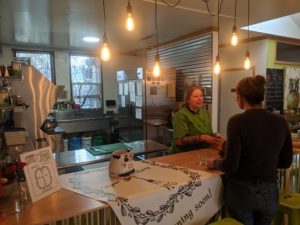
Join us for an informal dinner and meeting to elect officers and decide on major study issues for the upcoming year. This year we will visit the newly-opened vegan restaurant, created by the former chef at Leap of Taste, Liz Arraj, featuring Mediterranean, Spanish, Greek, Middle Eastern, Central-Italian cuisines. We will be there after regular hours, and will order from a list of special items. Expect dinner to cost around $10-$15. For more information and to RSVP, contact Leslie Lowe.
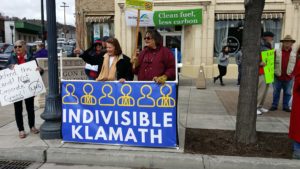
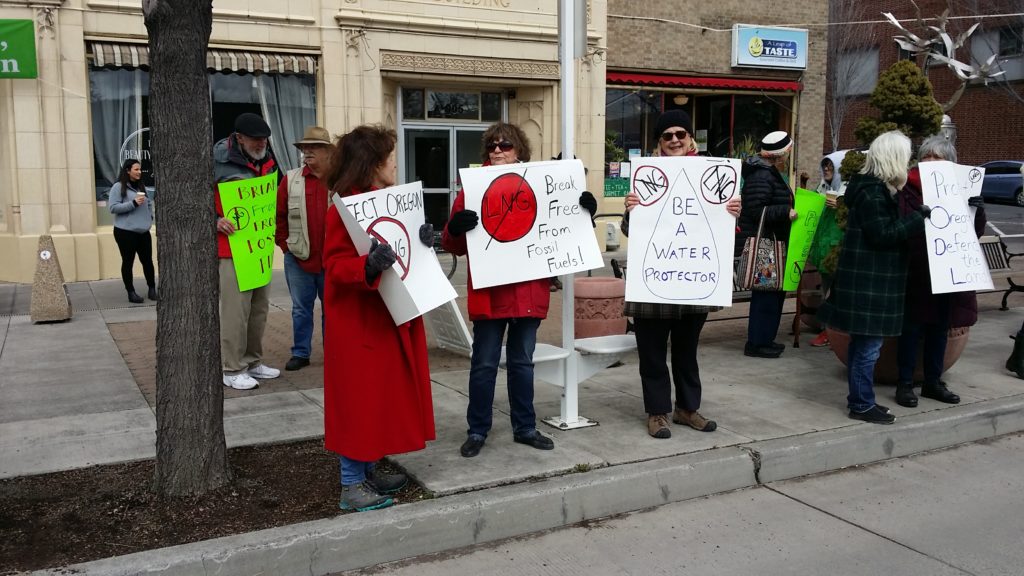
On Thursday March 28, 2019, several members of LWV Klamath County joined with others to demonstrate against the proposed LNG pipeline. This was part of our continuing efforts to engage in activities relevant to our community. Attending were Valerie Lenardson, Diane Eastman -Shockey, Christina Pasillas, Julie Ryder, Leslie Lowe, and former LWV member Barbara Turk.
According to a recent Klamath Indivisible press release:
The
proposed Pacific Connector gas pipeline would be built across public
and private lands. After 13 years, 60 landowners object to this pipeline
and could have their land seized by eminent domain;
The
pipeline would cross 485 rivers, streams and wetlands including the
Rogue, Klamath and Umpqua rivers, and impact the fishing and tourist
industries;
Constructing the pipeline would require
clear-cutting a 95-foot buffer through public lands, impacting a region
with significant fire and earthquake hazards;
The pipeline would carry 1.6 billion cubic feet of fracked gas per year;
Despite
Pembina’s claims in its thousands of TV ads and mailers, LNG pipelines
are not safe. Gas pipelines and facilities are highly explosive, and
have resulted in injuries, deaths and evacuations;
The pipeline would end at a huge refinery called Jordan Cove, built at Coos Bay, on our pristine and protected Oregon coast;
The
project threatens cultural resources, traditional tribal territories
and burial grounds of the Karuk, Yurok and Klamath Tribes. They oppose
the project;
The project would not result in additional jobs. An
estimated 1,000 temporary workers would be involved with the
construction, most from out of state;
Promoting more Liquified
Natural Gas is a huge step backward for fighting climate change.
Fracking wells produce substantial amounts of methane which could be
worse than coal in a 20-year timeframe. The U.S. Department of Energy
says shipping natural gas from the U.S. to Asia could end up being worse
than if China simply built a new power plant and burned its own coal
supplies. And the terminal would become the largest source of climate
pollution in the state;
The project benefits two foreign
interests: Pembina, a Canadian fossil fuels company, and the Asian
markets that will receive the LNG shipped from Jordan Cove.
Pembina continues to progress its proposed liquefied natural gas export
terminal in Coos Bay, Oregon, and the related Pacific Connector Gas
Pipeline that will transport natural gas from the Malin Hub in southern
Oregon to the export terminal. In September 2017, the Company filed
applications with the United States Federal Energy Regulatory Commission
(FERC) for the construction and operation of Jordan Cove. The Company
received a FERC Notice of Schedule during Q3 2018 and based on that
notice, currently anticipates a final FERC decision on Jordan Cove in
November of 2019. Pembina continues to anticipate first gas in 2024,
pending the receipt of the necessary regulatory approvals, a positive
final investment decision and other requirements.
Project highlights:
7.8 MMTPA (~1.3 Bcf/d) greenfield liquefied natural gas export facility
Price competitive with USGC brownfield on a delivered into Tokyo basis
9 days shipping to Tokyo with no hurricane risk or Panama Canal risk
Access to long-term and diverse natural gas supply from WCSB and US Rockies
Large-scale existing regional gas transportation network
~229 mile (~369 km) greenfield pipeline to connect Malin Hub in southern Oregon to Jordan Cove Terminal